New paper: can the EHT tell Kerr from Kerr–Hayward?
My paper is out: Phys. Rev. D 114, 023008.
What would happen if we traded off the philosophical discomfort of the curvature singularity of a black hole with some other physical problems (energy condition violations)?
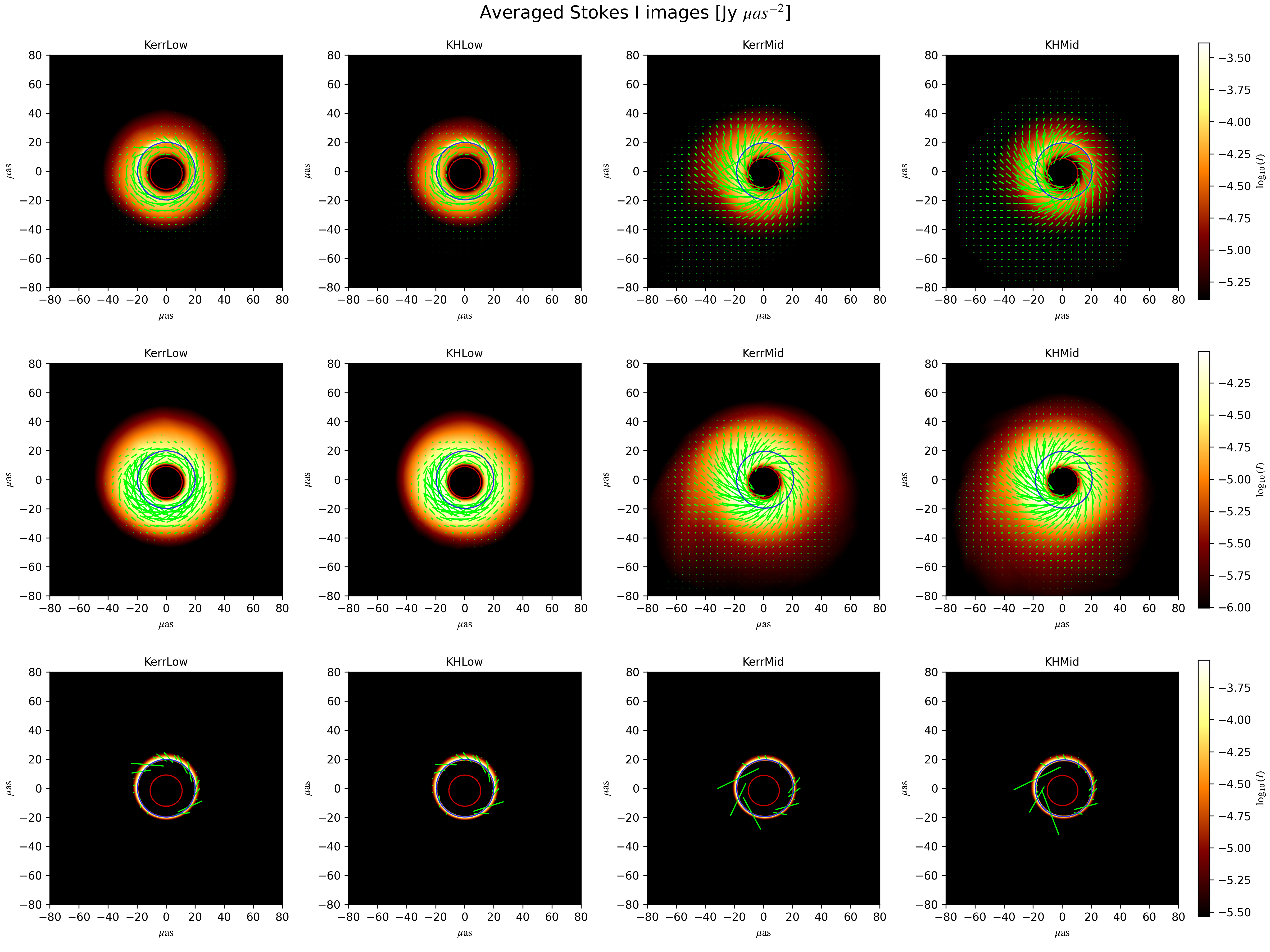
Result: We show that a phenomenological correction to the Kerr metric known as the Kerr-Hayward metric can eliminate the curvature singularity while preserving in detail many features of polarized black hole images now testable by the Event Horizon Telescope (EHT).
Full abstract: Astrophysical black holes appear well-represented by the Kerr metric, whose maximal analytic extension contains a ringlike curvature singularity. We study a phenomenological regularized modification of Kerr, the modified Kerr-Hayward metric, which removes curvature blowup at the level of the stationary metric while preserving in detail many features of polarized black hole images now testable by the Event Horizon Telescope (EHT). To establish this, we produce new general relativistic magnetohydrodynamics (GRMHD) simulations of a magnetized plasma in a Kerr-Hayward spacetime, then we extend the EHT analysis framework to perform polarized radiative transfer in this spacetime. We detail our methodology for implementing this modified spacetime into an open-source pipeline. From fluid quantities such as the magnetic flux parameter and jet efficiency, to image quantities such as the polarization pattern and the photon ring structure, our results for the Kerr-Hayward metric appear functionally indistinguishable from the Kerr metric. Our study finds that under the assumptions of a fixed-background GRMHD and polarized radiative transfer pipeline, this regularized phenomenological modification to the Kerr metric can yield observables that are effectively indistinguishable in EHT measurements.